Digital Dental Scanning in North Delta: What to Expect and Why It Matters
The End of the Putty Impression
If you have had a crown, a nightguard, or orthodontic work done in the past, you likely remember the experience of having a tray of thick, chalky putty pressed into your mouth and held there for several minutes while it set. For many patients. Especially those with a sensitive gag reflex. This was the most unpleasant part of the appointment.
Digital intraoral scanning has changed that entirely. A small wand, roughly the size of an electric toothbrush handle, captures thousands of images per second as it moves through your mouth. Within minutes, a precise, three-dimensional model of your teeth appears on a screen. Detailed enough to plan crowns, assess your bite, and communicate directly with a dental laboratory, all without a gram of impression putty.
This is not a niche technology. It is now standard equipment in modern dental practices across Canada, and for good reason.
What Is Digital Dental Scanning?
An intraoral scanner is a handheld device with a small camera tip that the dentist or hygienist moves along the surfaces of your teeth and gums. The device captures thousands of data points per second, stitching them together into a highly accurate 3D digital model. Sometimes called a digital impression or digital scan.
The scan is displayed in real time on a monitor, which allows both the patient and the dental team to see exactly what is being captured. For many patients, this is the first time they have ever clearly seen the shape and condition of their own teeth.
The resulting digital file is used directly in treatment planning and is transmitted electronically to dental laboratories for the fabrication of restorations like crowns, bridges, and veneers.
What Is Digital Scanning Used For?
Intraoral scanning has broad clinical applications. At Evolve Dental Studio, we use digital scans for:
Crowns and Bridges
Digital scans allow for precisely fitted crowns with significantly less chair time than traditional methods. The digital file is sent directly to the lab. No physical impressions to ship, no risk of distortion in transit.
Nightguards and Occlusal Splints
A perfectly fitted nightguard begins with a precise scan. Traditional putty impressions can distort as they set, leading to guards that need repeated adjustments. Digital scans virtually eliminate this issue.
SureSmile and Clear Aligner Therapy
Clear aligner systems such as SureSmile require digital scans rather than physical impressions. The scan feeds directly into the aligner software to produce a treatment simulation. Meaning patients can see a projected outcome before committing to treatment.
Implant Planning
Digital scans, combined with cone beam CT imaging where needed, allow for highly precise implant placement planning. The scan shows existing tooth structure and gum contours in detail.
Veneers
Cosmetic cases benefit enormously from digital scanning. The scan allows for digital smile design. Where the proposed result is visualized on the patient's actual tooth anatomy before any irreversible treatment begins.
Routine Records
Some clinics now take digital scans as part of routine exams to track changes in tooth wear or alignment over time.
What to Expect During the Scan
The process is straightforward and quick.
Before the scan: No special preparation is needed. You will sit in the dental chair as you normally would.
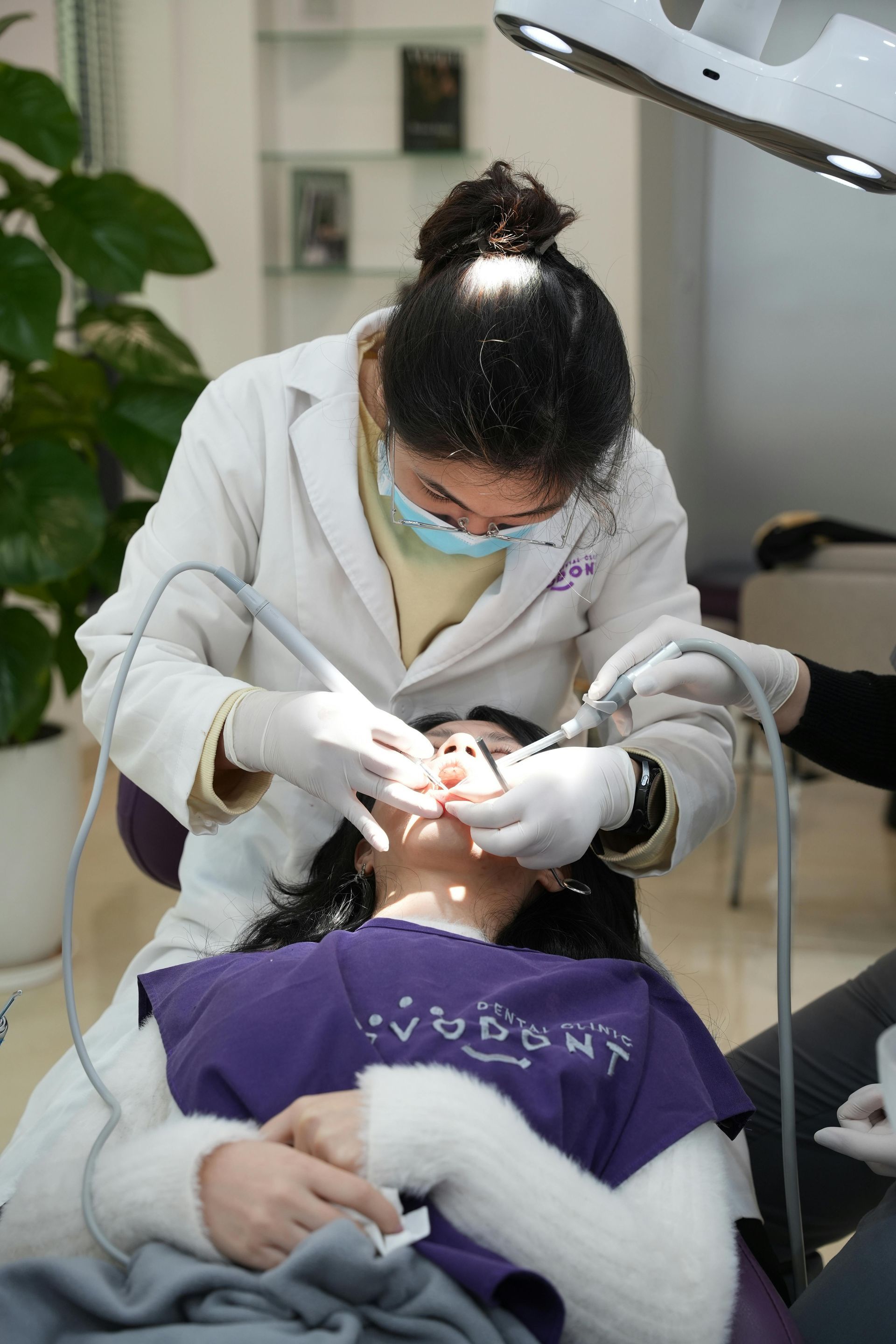
During the scan: The scanning wand is passed along the surfaces of your upper and lower teeth in a systematic pattern. Outer surfaces, inner surfaces, and biting surfaces. The dentist or dental assistant moves the wand slowly and methodically, pausing to capture each section clearly. The process is quick. Often complete in just a minute or two per arch, depending on the case.
What you feel: Very little. The wand is small and warm (it is gently heated to prevent fogging). Most patients find it far more comfortable than a traditional impression. There is no taste, no hardening material, and no need to stay still for an extended period.
For patients with a strong gag reflex: This is one of the most significant advantages of digital scanning. Because nothing is pressed against the back of the palate or throat, the scanning process is much better tolerated by patients who previously found impressions extremely difficult.
The result: A real-time 3D model appears on the screen during and immediately after the scan. Your dental team can review it with you, show you specific areas of interest, and explain the treatment plan with the actual visual in front of you.
How Accurate Is Digital Scanning Compared to Traditional Impressions?
Accuracy is one of the most studied aspects of intraoral scanning. A 2024 review in a peer-reviewed dental journal, drawing on scientific literature across digital dentistry, found that intraoral scanners demonstrate strong trueness and precision for single-unit restorations and short-span bridges. Comparable to or exceeding traditional impression techniques in controlled conditions.
For patients, this translates to fewer remakes, better-fitting restorations, and reduced chair time. Traditional putty impressions are subject to distortion from patient movement, material inconsistency, and transit to the lab. Digital files do not distort.
Health Canada has approved intraoral scanning technology for clinical use in Canada, and the technology is now standard equipment in modern dental practices across the country.
Digital Scanning and Canadian Dental Laboratories
One concern some clinics initially raised about digital scanning was compatibility with existing dental laboratories. Canadian dental labs have largely moved to accept digital files directly. This means patients in North Delta and the Lower Mainland benefit from faster turnaround times on restorations, with the digital file transmitted to the lab the same day the scan is taken.
Why Some Clinics Still Use Traditional Impressions
Traditional impressions have not disappeared entirely. Some clinicians still prefer them for specific cases. Particularly full-arch edentulous (toothless) impressions, or in situations where a patient cannot tolerate the scanning wand for an extended period. Some restorations also still perform best with physical models in certain laboratory workflows.
A well-equipped dental practice uses the right tool for the situation. The shift toward digital scanning has been significant and continued, but it is not universally applied in every clinical scenario.
Digital Dentistry at Evolve Dental Studio in North Delta
At Evolve Dental Studio, a commitment to digital technology is built into how we work. We use modern digital tools at every stage of patient care. From initial assessment through to treatment planning and restoration. Because they consistently produce better results and a more comfortable experience.
For patients in North Delta, Delta, Surrey, and the surrounding Lower Mainland, this means appointments that are more efficient, impressions that are more accurate, and a treatment process where you can see exactly what is happening in real time rather than waiting for results you cannot visualize.
Digital scanning is one part of that commitment. If you have been putting off a crown, a nightguard, or a clear aligner consultation because of past negative experiences with traditional impressions, it is worth knowing that the experience at a digitally equipped practice is considerably different.
Same-day appointments are available during operating hours.
Final Thoughts
Digital intraoral scanning is not a luxury feature. It is a practical improvement in the accuracy, comfort, and efficiency of dental care. For patients, it means a faster, more comfortable appointment and better-fitting results. For the dental team, it means clearer data and a more direct communication line with the laboratory.
If you are due for a crown, a nightguard, or any restoration, and you have not experienced a digital scan, ask about it at your next appointment. The difference from traditional impressions is immediately obvious.